
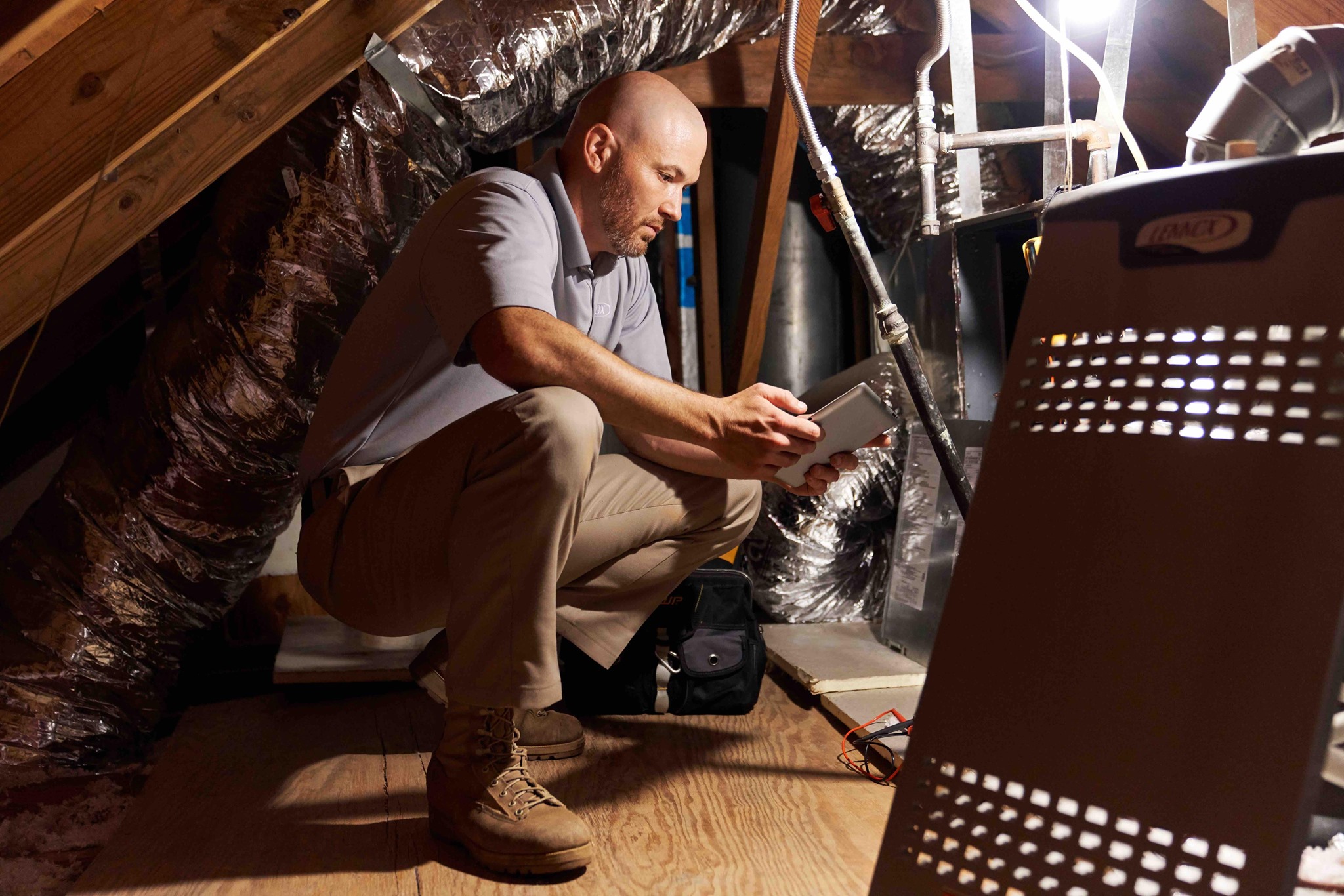
Heat Pump Installation in Chula Vista & San Diego County
One system that heats and cools. Heat pumps suit San Diego's climate better than almost anywhere in the country.
A heat pump both cools and heats your home with one system. In summer it works exactly like an air conditioner. In winter it runs in reverse, moving warmth from the outside air into your house. That reversal surprises people, but it is the same physics your refrigerator uses, and it works far below any temperature San Diego County sees.
Heat pump installation in this area typically runs $9,000 to $16,000 before rebates, depending on the size your home actually needs, the efficiency tier you choose, whether your ductwork can carry the airflow, and whether the electrical panel needs work. We run an ACCA Manual J calculation before quoting equipment rather than sizing off the label on your old system.
The honest case for a heat pump is strongest when your furnace and air conditioner are both aging, because one system then replaces two. If you have a recently replaced furnace that works fine, we will tell you that replacing only the failed cooling half costs less today.
What's included
- Ducted heat pumps that reuse your existing ductwork
- Ductless and multi-zone heat pumps for homes without ducts
- Dual-fuel systems for the colder inland valleys
- ACCA Manual J sizing on every installation quote
- Permits pulled and closed out, which SDG&E requires before releasing any rebate
- Commissioning by measurement: superheat, subcooling, static pressure and temperature split
What the efficiency numbers actually mean
Furnaces are rated by AFUE, which is simply the percentage of fuel that becomes heat inside your house rather than going out the flue. A standard furnace runs around 80% AFUE. A condensing furnace, which pulls a second round of heat out of the exhaust before venting it, runs 90% or higher. Heat pumps get measured twice, SEER2 for cooling and HSPF2 for heating, and the federal minimum for a new split-system heat pump is 14.3 SEER2 and 7.5 HSPF2.
San Diego winters sit in the range where heat pumps are at their most efficient, so the cold-weather objection you may have read about does not apply here the way it does in colder states. If you are replacing both a furnace and an aging air conditioner, a single heat pump is worth pricing against two separate systems, because one piece of equipment then covers both jobs and SDG&E rebates on qualifying heat pumps are among the better utility incentives still running in 2026.
The equipment we install and service
We install and service Carrier, Trane, Lennox, Rheem, Goodman, York, American Standard and Bryant systems, and for ductless and heat pump work we install Mitsubishi Electric, Daikin, LG and Bosch. Carrying multiple lines matters more than it sounds, because it means the recommendation you get is based on what fits your house and your budget rather than on the one brand a company is locked into.
It matters for repairs too. Our trucks stock the parts that actually fail on these systems, which are usually capacitors, contactors, blower motors, ignitors and flame sensors, so most repair calls finish the same day rather than turning into a parts-ordering exercise. One thing worth knowing if your system is more than about fifteen years old: the industry has moved off R-410A refrigerant to lower-emission blends such as R-454B. Older R-22 systems are the ones where a refrigerant leak turns into a replacement conversation, because that refrigerant is no longer produced. We will tell you which side of that line your system sits on before you spend money on it.
Why we measure your house before quoting equipment
The most common mistake in this trade is sizing a replacement by reading the label on the old system. If the original was wrong, and many were, you inherit that mistake for another fifteen years. We run an ACCA Manual J load calculation instead, which works out how much heating and cooling your specific house actually needs based on square footage, insulation, window area and orientation, ceiling height and air leakage. Manual S then matches equipment to that load, and Manual D confirms your existing ductwork can carry the airflow the new system expects.
Oversizing is the failure mode people do not expect. A system that is too large cools quickly, satisfies the thermostat and shuts off before it has run long enough to pull humidity out or distribute evenly. That is short cycling, and it produces hot and cold spots, higher bills and a compressor that wears out early. Bigger is not better. Correct is better.
Rebates and incentives, and what actually changed
Start with the part most contractors have not updated on their websites: the federal 25C energy efficiency tax credit ended on December 31, 2025. If you had qualifying work done in 2025 you can still claim it on that year's return, but there is no federal HVAC tax credit for work done today. Anyone still quoting you a $600 or $2,000 federal credit on a new system is working from old information, and you should ask them what else on their quote is out of date.
What is still available in San Diego is the utility side. SDG&E runs equipment rebates that generally fall in the $200 to $500 range on qualifying high-efficiency systems, with smart thermostat rebates on top of that, and there are additional income-qualified programs for households at or below 80% of area median income. One detail that catches people out: SDG&E requires your local permit to be pulled and closed out before it will release an incentive, so a contractor who skips the permit also costs you the rebate. We pull permits on every installation and handle the close-out. Statewide GoGreen Home financing is also available, separate from our own financing on approved credit. We will confirm which programs you actually qualify for at quote stage rather than promising a number we cannot deliver.
The part homeowners underestimate is the SDG&E bill itself. San Diego electricity rates are among the highest in the country and are billed on time-of-use pricing, so the hours your system runs cost different amounts. An older system running through the expensive late-afternoon window is quietly costing you more than the same system would in most other states, which shortens the payback period on an efficiency upgrade here compared to the national averages you will read elsewhere.
The HVAC Pilot Difference
The same job, a very different experience. Here is how we compare to the typical service call.
| What matters to you | HVAC Pilot | The Typical Call |
|---|---|---|
| On-time arrival, no all-day windows | Hit or miss | |
| Upfront flat-rate pricing you approve first | Surprise bills | |
| Repair-first, honest advice (no pushy upsells) | Replace-first | |
| Licensed, bonded & insured (CSLB #1079616) | Often unclear | |
| One team for HVAC, plumbing & electrical | Call around | |
| Your details go to us, never sold to other contractors | Sold as a lead |
Save on Your Next Service
Limited-time savings for San Diego County homeowners. Mention the offer when you book — and ask about financing on approved credit.
Mention this offer when you book. One offer per household; cannot be combined with other offers; restrictions may apply. Call (858) 264-2677 for details.
Four Promises We Put in Writing
Booking a contractor should not feel like a gamble. Every HVAC Pilot visit is backed by four simple commitments.
On-Time or We Call Ahead
A real appointment time and a call if anything changes. No vanishing four-hour windows.
Upfront Flat-Rate Pricing
You see and approve the price before we touch a thing. The number we quote is the number you pay.
Repair-First, Never Pushy
If a fix will do, we fix it. We only recommend replacement when it truly saves you money.
Done Right & to Code
Licensed, insured technicians and workmanship we stand behind, verified with you before we leave.
The HVAC Pilot Pre-Flight Check
The same clear, four-step process on every visit so you always know what is happening and what it costs before any work begins.
Pre-Flight Inspect
A thorough on-site diagnosis, not a guess over the phone.
Honest Diagnosis
We explain what is actually wrong, in plain language.
Upfront Quote
Flat-rate pricing you approve before we touch a thing.
Verified Repair
We finish the work and test it with you to confirm it is right.
Explore More
Heat Pump Installation in Chula Vista & San Diego County FAQs
Do heat pumps work in cold weather?
Yes, and comfortably so here. Modern inverter-driven heat pumps produce useful heat well below freezing, and cold-climate models operate down to roughly -13F. Chula Vista rarely drops below the mid-40s, and even the colder inland parts of San Diego County stay well inside the range where a heat pump runs efficiently. The cold-weather objection you may have read about applies to northern states, not to this climate.
How much does a heat pump cost in San Diego?
Most residential heat pump installations in San Diego County run $9,000 to $16,000 before rebates. What moves the number is the size your home actually needs, the efficiency tier, the condition of your ductwork, whether your electrical panel can support the equipment, and access at the installation location. We quote a flat rate you approve before any work starts.
Is there still a federal tax credit for heat pumps?
No. The federal 25C energy efficiency tax credit ended on December 31, 2025. Work completed during 2025 can still be claimed on that year's return, but there is no federal HVAC tax credit for installations done today. SDG&E utility rebates on qualifying high-efficiency equipment are still running, and we will tell you which ones your system actually qualifies for.
Will a heat pump raise my electric bill?
Your electric bill goes up and your gas bill goes down or disappears. For most San Diego homes the combined total drops, because a heat pump moves heat rather than generating it and delivers roughly three units of heat per unit of electricity. Homes replacing electric resistance heating see the biggest savings. If you have a very efficient existing gas furnace, the change is smaller, and we will run the numbers honestly before recommending the switch.
How long does a heat pump last?
Typically 15 to 20 years with regular maintenance. Coastal homes in Imperial Beach, Coronado or Carlsbad should expect the lower end of that range, because salt air corrodes outdoor coils faster. Inland systems in El Cajon or Santee commonly reach the upper end. Annual maintenance, and coil cleaning in particular near the coast, makes a measurable difference.
What size heat pump do I need?
That comes from an ACCA Manual J load calculation on your specific house, not a square-footage rule of thumb. Oversizing is the failure mode people do not expect: the system satisfies the thermostat quickly and shuts off before it has run long enough to distribute evenly or pull humidity out, which produces hot and cold spots, higher bills and premature compressor wear.
Do I need a permit?
Yes. Heat pump installation requires a mechanical permit in San Diego County jurisdictions. We pull it and close it out. This matters beyond code compliance: SDG&E will not release a rebate without proof the permit was closed, so a contractor who skips the permit also costs you the incentive.
Request Your Free Estimate
Tell us what you need and we will get a licensed technician out fast. Your details go straight to our team, never sold to other contractors.